Mengyun Wang
AI Engineer · Meta
Infrastructure for large-scale AI systems and LLM agents
I build the infrastructure that AI systems run on: distributed data pipelines and query engines serving multi-million-QPS traffic, and, more recently, the layer underneath LLM agents — durable runtimes, retrieval, sandboxed execution, and the evaluation harnesses that decide whether a change ships.
The thread through all of it is reliability under real load: exactly-once delivery on a live stream, an agent run that survives its own process dying, a benchmark that means the same thing tomorrow as it does today.
News
2026.09
Published a two-layer LLM inference stack:
LLM Serving Platform
for the control plane and
InferenceGateway
for Ray Serve + vLLM GPU execution.
2026.09
Built Atlas —
a five-agent committee with a human approval gate, durable state, and a live event stream.
Try the demo →
2026.08
Started Blogs — daily notes on
AI engineering and evaluation.
2026.08
Released GroundTruth —
exposure-bias measurement on real Kuaishou logs.
2026.08
Published Cognitive Shorts,
four deployable services around one engagement model.
Projects
Atlas
Five agents — Planner, Safety, Coder, Browser, Verifier — run by one
orchestrator that owns every state change. Plans are scored twice, by the Safety agent and by fixed
rules, and anything over the line waits for a person before it runs. Steps retry, the Verifier can
send work back once, and every event is in the database before it reaches the UI, so a task
survives a restart and can be replayed. Code runs in a locked-down container; web fetches are
checked against private networks. Runs end-to-end with no model keys.
LLM Serving Platform
An OpenAI-compatible gateway and operations layer for model engines.
Requests move through authentication, rate limiting, a prefix-response cache, warm-pool
coordination, adaptive backend routing, and dynamic micro-batching before reaching an
upstream engine. The console exposes chat, routing health, cache and batch state, model
governance, and canary, rolling, and blue-green release controls.
InferenceGateway
The engine layer beneath the serving platform: Ray Serve ingress
drives vLLM’s AsyncLLMEngine with continuous batching, PagedAttention, prefix KV caching,
bounded request concurrency, and OpenAI-compatible SSE. A Hugging Face baseline and async
load generator measure TTFT, tail latency, tokens per second, and goodput; Prometheus reads
vLLM and NVIDIA DCGM metrics for GPU and cache visibility.
Cognitive Shorts
An engagement prediction system taken from notebook to something
operable: leakage-safe features, cost-aware model selection under a paired-bootstrap tie
test, an operating point chosen against a traffic budget, then introspection and drift
monitoring around it.
The four services, in reading order
01Single PredictionIs the model right?
02Batch PredictionDoes it hold up at volume?
03Model InfoIs the artefact in memory the one that was shipped?
04Analytics DashboardIs it still healthy today?
MLE Prep
A growing question bank for machine-learning-engineer interviews — ML
coding, theory, LLMs and agents, ML systems, MLOps, recommender systems, AI safety, multimodal
and behavioural — filterable by category and difficulty. Reference answers give an answer
framework, key points, common follow-ups and further reading; anything unclear can be handed
to Claude or ChatGPT for a walkthrough.
GroundTruth
Kuaishou injected uniformly random videos into live feeds for two
weeks. Testing on both exposure mechanisms across the identical window isolates exposure
bias from drift — ranking survives it almost intact, calibration does not.
Blogs
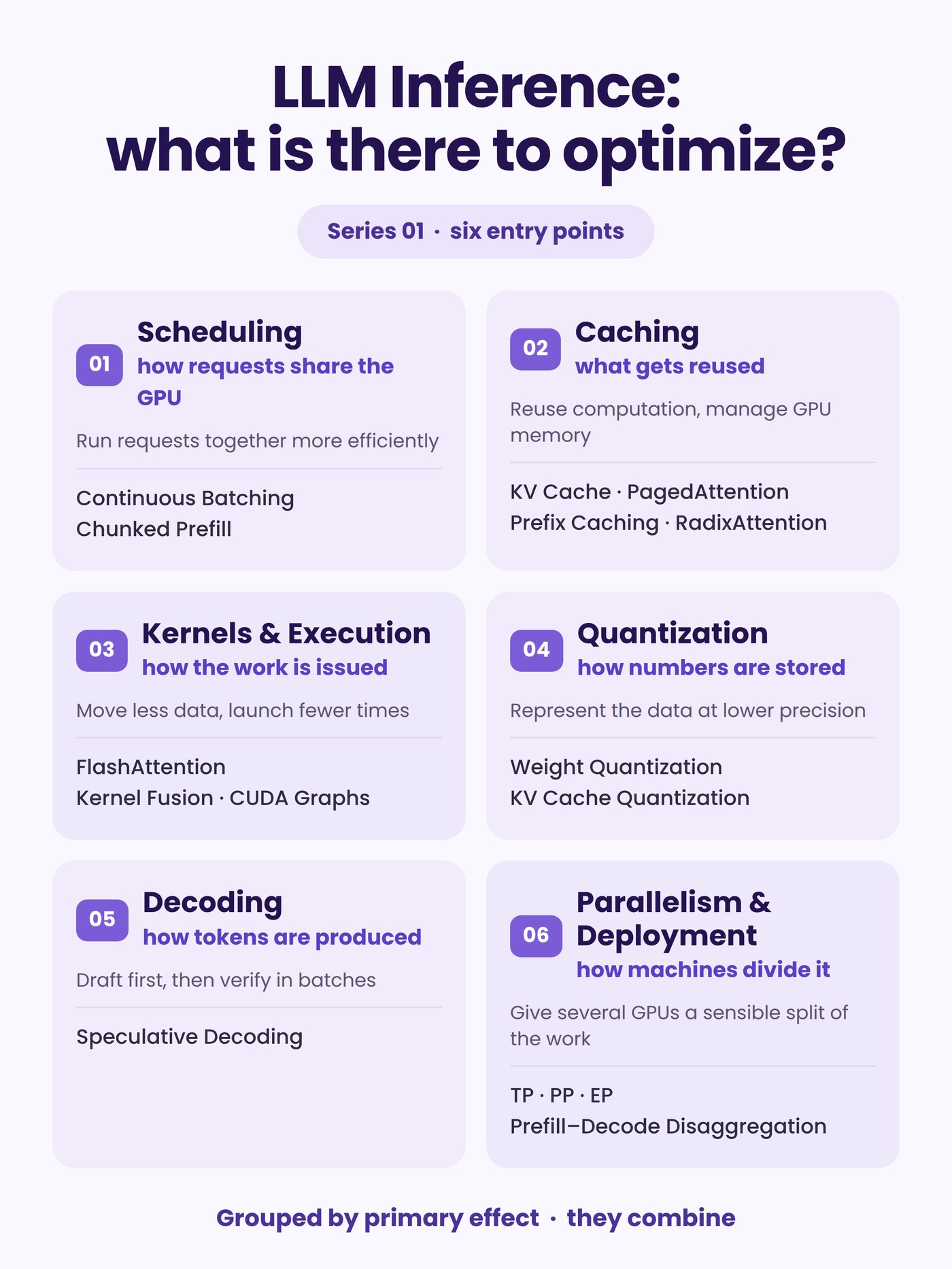
LLM inference in cards: the map, and scheduling
A card series on where a serving stack actually loses time. The map first — six entry points that combine — then scheduling in detail: batching reuses one read of the weights, continuous batching updates the batch every iteration, and chunked prefill caps what a long prompt can do to everyone else's inter-token latency.
MCP is not dead — it is just not a personal-productivity tool
The CLI-versus-MCP argument is really an ownership question: how many
people have to agree when a tool definition changes. And both camps are arguing about
invocation while nobody argues about whether the call should have happened at all.